Logarithme
Table des matières
Le logarithme népérien
Définition
Activité
La fonction \(x \mapsto \dfrac{1}{x}\) est continue sur \(]0;+\infty[\) ; elle admet donc une primitive sur \(]0;+\infty[\). Parmi toutes ses primitives, il en existe une seule qui s’annule en \(1\).
Définition
L’unique primitive de la fonction \(x \mapsto \dfrac{1}{x}\) sur \(]0;+\infty[\) qui s’annule en \(1\) est appelée fonction logarithme népérien, notée \(\ln\).
Conséquence
-
\(D_{\ln} = \,]0\,;+\infty[\) ; \(\ln(1) = 0\).
-
\(\ln\) est dérivable sur \(]0;+\infty[\) et\(\forall x \in\,]0;+\infty[,\; (\ln x)' = \dfrac{1}{x}\).
-
\(\ln\) est strictement croissante sur \(]0;+\infty[\).
Premières propriétés
Proposition
Soient \(x, y \in\,]0;+\infty[\).
-
\(\ln(x) \leq \ln(y) \Longleftrightarrow x \leq y\).
-
\(\ln(x) = \ln(y) \Longleftrightarrow x = y\).
Exemple
Déterminer le domaine de définition de \(f(x) = \ln(x^2 - 1)\).
Application
Déterminer le domaine de définition de chaque fonction :
-
\(f_1(x) = \ln(1-x)\)
-
\(f_2(x) = \ln(x^2 + 1)\)
-
\(f_3(x) = \ln\!\left(\dfrac{x-1}{x+2}\right)\)
À faire à la maison
-
Résoudre dans \(\mathbb{R}\) : (a) \(\ln(3x - 1) = \ln(1 - x)\) ; (b) \(\ln(2x + 5) > \ln(x^2 + 4)\).
-
Soit \(f(x) = \ln\!\left(\dfrac{x^2 - 4}{x + 1}\right)\). Déterminer \(D_f\).
-
Résoudre dans \(\mathbb{R}\) : \(\ln(x) + \ln(x - 2) = \ln(3)\).
Propriétés algébriques
Propriété
Soient \(a, b \in\,]0;+\infty[\), \(r \in \mathbb{Q}\) et \(n \in \mathbb{N}\).
-
\(\ln(ab) = \ln(a) + \ln(b)\)
-
\(\ln\!\left(\dfrac{a}{b}\right) = \ln(a) - \ln(b)\)
-
\(\ln\!\left(\dfrac{1}{a}\right) = -\ln(a)\)
-
\(\ln(a^n) = n\,\ln(a)\)
-
\(\ln(a^r) = r\,\ln(a)\)
-
\(\ln(\sqrt{a}) = \dfrac{1}{2}\ln(a)\)
Remarque
-
Si \(xy > 0\), alors \(\ln(xy) = \ln(|x|) + \ln(|y|)\).
-
Pour tout \(x \in \mathbb{R}^*\) : \(\ln(x^2) = 2\ln(|x|)\).
Exemple
Écrire \(A = \ln(80)\) en fonction de \(\ln(2)\) et \(\ln(5)\).
Application
Écrire en fonction de \(\ln(2)\) :
-
\(A = 3\ln(2) + \ln(4)\)
-
\(B = \ln(\sqrt{8})\)
-
\(C = \ln(20) - \ln(5)\)
À faire à la maison
-
Soient \(a, b > 0\). Démontrer (en utilisant les propriétés algébriques) que \(\ln(a^2 b^3) - \ln\!\left(\dfrac{a}{b}\right) = \ln(a) + 4\ln(b)\).
-
Résoudre dans \(\mathbb{R}\) : \(2(\ln x)^2 + \ln(x) - 6 = 0\).
-
Résoudre dans \(\mathbb{R}^2\) : \(\begin{cases} 3\ln(x) + \ln(y) = 2 \\ 2\ln(x) - 3\ln(y) = 5 \end{cases}\).
Le nombre \(e\) et limites de référence
Le nombre \(e\)
Définition
La fonction \(\ln\) étant continue et strictement croissante de \(]0;+\infty[\) sur \(\mathbb{R}\), le théorème des valeurs intermédiaires (TVI) affirme l’existence d’un unique réel, noté \(e\), tel que \(\ln(e) = 1\). On a \(e \approx 2{,}718\).
Conséquence
Pour tout \(r \in \mathbb{Q}\) :
-
\(\ln(e^r) = r\).
-
\(\ln(x) = r \Longleftrightarrow x = e^r\).
Exemple
Simplifier \(A = \ln(e^2) + \ln(e^4) - \ln\!\left(\dfrac{1}{e}\right)\).
Limites essentielles
Propriété
-
\(\lim\limits_{x \to +\infty} \ln(x) = +\infty\)
-
\(\lim\limits_{x \to 0^+} \ln(x) = -\infty\)
-
\(\lim\limits_{x \to +\infty} \dfrac{\ln(x)}{x} = 0\)
-
\(\lim\limits_{x \to 0^+} x \ln(x) = 0\)
-
\(\lim\limits_{x \to +\infty} \dfrac{\ln(x)}{x^n} = 0\), \(n \in \mathbb{N}^*\)
-
\(\lim\limits_{x \to 0^+} x^n \ln(x) = 0\), \(n \in \mathbb{N}^*\)
-
\(\lim\limits_{x \to 1} \dfrac{\ln(x)}{x-1} = 1\)
-
\(\lim\limits_{x \to 0} \dfrac{\ln(1+x)}{x} = 1\)
Exemple
Calculer \(\lim\limits_{x \to +\infty} \dfrac{(\ln x)^3}{x}\).
Application
Calculer les limites suivantes :
-
\(\lim\limits_{x \to +\infty} \ln(x) - x\)
-
\(\lim\limits_{x \to +\infty} \dfrac{x}{\ln x}\)
-
\(\lim\limits_{x \to 0^+} \dfrac{1}{\ln x}\)
-
\(\lim\limits_{x \to +\infty} x\,\ln\!\left(1+\dfrac{1}{x}\right)\)
À faire à la maison
-
Calculer les limites :
-
\(\lim\limits_{x \to +\infty} \dfrac{(\ln x)^2 - \ln x}{x}\)
-
\(\lim\limits_{x \to 0^+} x^2 (\ln x)^3\)
-
\(\lim\limits_{x \to +\infty} \dfrac{\ln(x^2 + 1)}{x}\)
-
\(\lim\limits_{x \to +\infty} \sqrt{x}\,\ln\!\left(1 + \dfrac{1}{\sqrt{x}}\right)\)
-
-
Soit \(f(x) = \dfrac{\ln(1+2x)}{3x}\) pour \(x > -\dfrac{1}{2}\), \(x \neq 0\).
-
Calculer \(\lim\limits_{x \to 0} f(x)\) (indication : faire apparaître \(\dfrac{\ln(1+t)}{t}\) avec \(t = 2x\)).
-
Calculer \(\lim\limits_{x \to +\infty} f(x)\).
-
Étude et représentation graphique de \(\ln\)
Tableau de variations
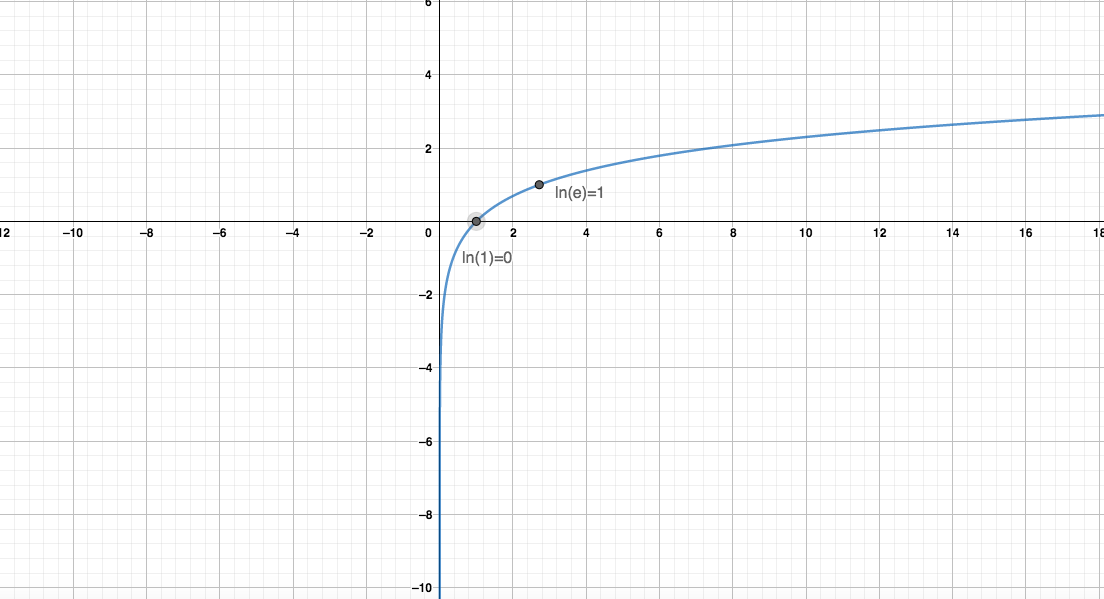
La fonction \(\ln\) est strictement croissante sur \(]0;+\infty[\) avec \(\ln'(x) = \dfrac{1}{x} > 0\), \(\lim\limits_{x \to 0^+}\ln(x) = -\infty\), \(\lim\limits_{x \to +\infty}\ln(x) = +\infty\), et \(\ln(1) = 0\), \(\ln(e) = 1\).
| \(x\) | \(0\) | \(+\infty\) | |
|---|---|---|---|
| \(\ln'(x)\) | ‖ | + | |
| \(\ln\) | \(-\infty\) | ↗\((1\,;\,0)\)\((e\,;\,1)\) | \(+\infty\) |
Concavité
Proposition
La fonction \(\ln\) est deux fois dérivable sur \(]0;+\infty[\) avec \(\ln''(x) = -\dfrac{1}{x^2}\). Donc \(\ln''(x) < 0\) pour tout \(x > 0\), et la courbe \((\mathcal{C}_{\ln})\) est concave sur \(]0;+\infty[\).
Branches infinies
-
\(\lim\limits_{x \to 0^+} \ln(x) = -\infty\) : asymptote verticale d’équation \(x = 0\).
-
\(\lim\limits_{x \to +\infty} \dfrac{\ln(x)}{x} = 0\) : branche parabolique de direction \((Ox)\) au voisinage de \(+\infty\).
Courbe représentative
Signe de \(\ln\)
Conséquence
| \(x\) | \(0\) | \(1\) | \(+\infty\) | ||
|---|---|---|---|---|---|
| \(\ln(x)\) | ‖ | − | 0 | + |
Exemple
Comparer les réels \(\ln(2) + \ln(5)\) et \(2\).
Application
-
Comparer \(\ln(0{,}9)\) et \(0\), puis \(\ln(5)\) et \(\ln(2) + 1\).
-
Déterminer le signe de \(\ln(2x - 1)\) selon les valeurs de \(x\).
Dérivée et primitive de \(\ln \circ u\)
Proposition
Soit \(u\) une fonction dérivable sur un intervalle ouvert \(I\). Si \(u\) ne s’annule pas sur \(I\), alors la fonction \(x \mapsto \ln|u(x)|\) est dérivable sur \(I\) et :
\[\forall x \in I,\quad (\ln|u(x)|)' = \dfrac{u'(x)}{u(x)}.\]
Exemple
Calculer la dérivée de \(f(x) = \ln(x^2 + 1)\) sur \(\mathbb{R}\).
Application
Calculer la dérivée de chaque fonction sur un intervalle approprié :
-
\(f_1(x) = \ln|x^2 - 4x + 3|\)
-
\(f_2(x) = \ln(\cos x)\)
-
\(f_3(x) = \ln\!\left(\dfrac{x+1}{x-1}\right)\)
Proposition
Soit \(u\) une fonction dérivable sur un intervalle \(I\) ne s’annulant pas sur \(I\). Les primitives de \(x \mapsto \dfrac{u'(x)}{u(x)}\) sur \(I\) sont :
\[x \mapsto \ln|u(x)| + k,\quad k \in \mathbb{R}.\]
Exemple
Déterminer une primitive de \(f(x) = \dfrac{x^3}{x^4 + 2}\) sur \(\mathbb{R}\).
Application
Déterminer une primitive de chaque fonction :
-
\(f_1(x) = \dfrac{2}{2x+1}\) sur \(\left]-\dfrac{1}{2};+\infty\right[\).
-
\(f_2(x) = \dfrac{1}{x-1}\) sur \(]-\infty;1[\).
-
\(f_3(x) = \dfrac{\cos x}{\sin x}\) sur \(\left]\dfrac{3\pi}{2};2\pi\right[\).
-
\(f_4(x) = \tan x\) sur \(\left]-\dfrac{\pi}{2};\dfrac{\pi}{2}\right[\).
Proposition
Soient \(a \in \overline{\mathbb{R}}\), \(b > 0\) et \(u\) une fonction strictement positive au voisinage de \(a\).
-
\(\lim\limits_{x \to a} u(x) = +\infty \Longrightarrow \lim\limits_{x \to a} \ln(u(x)) = +\infty\).
-
\(\lim\limits_{x \to a} u(x) = 0^+ \Longrightarrow \lim\limits_{x \to a} \ln(u(x)) = -\infty\).
-
\(\lim\limits_{x \to a} u(x) = b \Longrightarrow \lim\limits_{x \to a} \ln(u(x)) = \ln(b)\).
Application
Calculer les limites :
-
\(\lim\limits_{x \to -\infty} \ln\!\left(\dfrac{3x+5}{2x+1}\right)\)
-
\(\lim\limits_{x \to +\infty} \ln\!\left(\dfrac{x^2+3x-5}{x+2}\right)\)
-
\(\lim\limits_{x \to \frac{3}{2}^-} \ln\!\left(\dfrac{3-2x}{x+1}\right)\)
À faire à la maison
-
Calculer les dérivées :
-
\(f_1(x) = (\ln x)^3 - 2 \ln(x^3)\)
-
\(f_2(x) = \ln\!\left(\dfrac{1 + \sin x}{1 - \sin x}\right)\)
-
\(f_3(x) = x^2 \ln(1 + x^2)\)
-
\(f_4(x) = \ln|\tan x|\)
-
-
Déterminer une primitive de chaque fonction :
-
\(g_1(x) = \dfrac{2x + 3}{x^2 + 3x + 1}\) sur \(]0\,;+\infty[\)
-
\(g_2(x) = \dfrac{1 - 2x}{x^2 - x + 1}\)
-
\(g_3(x) = \dfrac{x+1}{x^2+2x+5}\) sur \(\mathbb{R}\)
-
\(g_4(x) = \dfrac{1}{x \ln x}\) sur \(]1;+\infty[\)
-
-
Étudier la fonction \(f(x) = x \ln x\) sur \(]0;+\infty[\) : limites aux bornes, dérivée, variations, branches infinies, et tracer l’allure de \((C_f)\).
Fonctions logarithmiques de base \(a\)
Définition
Définition
Soit \(a\) un réel strictement positif tel que \(a \neq 1\). La fonction définie sur \(]0;+\infty[\) par \(x \mapsto \dfrac{\ln x}{\ln a}\) est appelée fonction logarithme de base \(a\), et notée \(\log_a\). Ainsi :
\[\log_a(x) = \dfrac{\ln x}{\ln a},\quad \forall x \in\,]0;+\infty[.\]
Conséquence
Pour \(a > 0\), \(a \neq 1\) :
-
\(\log_a(a) = 1\)
-
\(\log_a(1) = 0\)
-
\(\log_a(e) = \dfrac{1}{\ln a}\)
-
\(\log_e = \ln\)
Propriétés algébriques
Propriété
Soient \(x, y \in\,]0;+\infty[\), \(r \in \mathbb{Q}\), \(a > 0\), \(a \neq 1\).
-
\(\log_a(xy) = \log_a(x) + \log_a(y)\)
-
\(\log_a\!\left(\dfrac{x}{y}\right) = \log_a(x) - \log_a(y)\)
-
\(\log_a\!\left(\dfrac{1}{y}\right) = -\log_a(y)\)
-
\(\log_a(x^r) = r\,\log_a(x)\)
Proposition
Soit \(a > 0\), \(a \neq 1\).
-
\(\forall x, y \in\,]0;+\infty[\) : \(\log_a(x) = \log_a(y) \Longleftrightarrow x = y\).
-
\(\forall x > 0,\; \forall r \in \mathbb{Q}\) : \(\log_a(x) = r \Longleftrightarrow x = a^r\).
Exemple
Calculer \(A = \log_2(8) - \log_3(27) + \log_5\!\left(\dfrac{1}{125}\right)\).
Dérivée et variations
Proposition
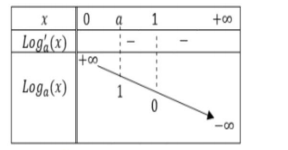
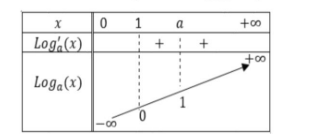
La fonction \(\log_a\) est dérivable sur \(]0;+\infty[\) et :
\[\forall x > 0,\quad (\log_a x)' = \dfrac{1}{x \ln a}.\]
-
Si \(a > 1\) : \(\log_a\) est strictement croissante sur \(]0;+\infty[\).
-
Si \(0 < a < 1\) : \(\log_a\) est strictement décroissante sur \(]0;+\infty[\).
Logarithme décimal
Définition
La fonction \(\log_{10}\) est appelée logarithme décimal et notée simplement \(\log\) :
\[\log(x) = \dfrac{\ln x}{\ln 10},\quad \forall x \in\,]0;+\infty[.\]
Propriété
Soient \(x \in\,]0;+\infty[\) et \(r \in \mathbb{Q}\).
-
\(\log(10^r) = r\)
-
\(\log(x) = r \Longleftrightarrow x = 10^r\)
-
\(\log(x) > r \Longleftrightarrow x > 10^r\)
-
\(\log(x) < r \Longleftrightarrow 0 < x < 10^r\)
Exemple
Simplifier \(A = \log(25000) + \log(\sqrt{250}) - \log(125)\).
Application
Résoudre dans \(\mathbb{R}\) :
-
\(\log_3(2x)\,(\log_5(x) - 1) = 0\)
-
\(2(\log x)^2 - 19 \log(x) - 10 = 0\)
À faire à la maison
-
Résoudre dans \(\mathbb{R}\) : \(\log_2(x) + \log_4(x) = 3\) (indication : \(\log_4(x) = \log_2(x)/2\)).
-
Résoudre dans \(\mathbb{R}\) : \(\log(x) + \log(x + 3) = 1\).
-
Le pH d’une solution est défini par \(\mathrm{pH} = -\log[\mathrm{H}^+]\) où \([\mathrm{H}^+]\) est la concentration en ions hydrogène en mol/L. Si une solution a un pH de \(3{,}5\), calculer \([\mathrm{H}^+]\). Si on multiplie cette concentration par \(100\), quel est le nouveau pH ?